Anyone who has managed a carbon black production line upgrade knows the frustration firsthand: equipment specs look impressive on paper, suppliers promise finished product fineness up to 2000 mesh with minimal dust — yet three months into production, problems emerge: uneven product fineness, classifier blockages, and premature wear part replacements.
For a related practical reference on recording clean voice tracks, see Sound Forge voice-over recording guide.
The issue typically isn't the carbon black feedstock itself, but rather a mismatch between the grinding equipment's original design and actual production conditions. This article covers the material characteristics of carbon black during grinding, the core differences between quality and standard equipment, and operational factors buyers commonly overlook.
Ring Roller Mills: The Preferred Equipment for Carbon Black Processing
Common carbon black processing equipment includes ball mills, Raymond mills, jet mills, and ring roller mills. Each has its applicable scenarios, but for high-volume industrial production of ultrafine carbon black in the 300–3000 mesh range, ring roller mills stand out as the mainstream choice.
The working principle: multiple grinding rollers travel along a circular track, using centrifugal force to continuously feed material into the grinding zone. Compared to impact-type mills, grinding is more uniform; compared to high-speed jet mills, overall temperature rise is lower — both critical factors, since temperature fluctuations directly affect carbon black properties.
Ring roller mills use a closed-loop circulation system that performs grinding and classification simultaneously: material that hasn't reached the target fineness automatically recirculates for re-grinding, while qualified powder is conveyed to the collection system via the classifier. This continuous loop produces particle size distributions far superior to batch-type or single-pass grinding equipment.
For carbon black processing, the negative-pressure operating mode of ring roller mills offers a distinct advantage. The entire system runs under slight negative pressure, completely preventing dust leakage — satisfying environmental requirements while ensuring stable quality for premium products.
The CRGM Series: Purpose-Built for Carbon Black Applications
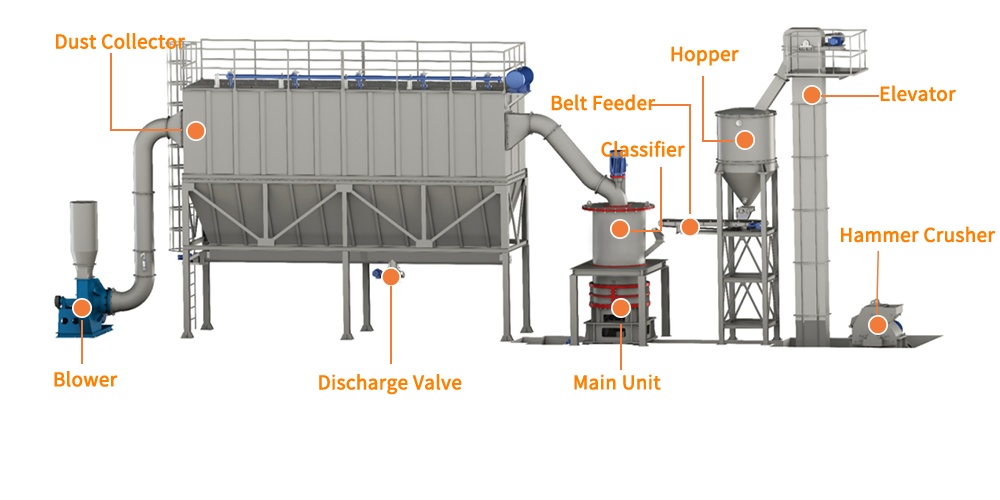
The Cronus CRGM series ring roller mill is not a repurposed general-purpose machine. It was developed through decades of continuous optimization specifically for carbon black applications, with every design aspect tailored to real-world carbon black processing requirements.
1. Wide Fineness Range with On-the-Fly Adjustment The CRGM series covers finished product fineness from 300 to 3000 mesh, adjustable without stopping the machine. For production lines that frequently switch between product grades, eliminating downtime for fineness adjustments significantly reduces capacity loss and improves overall economics.
2. Flexible Capacity Configuration The equipment comes in three main models — CRGM1000X, CRGM2000X, and CRGM3000X — selectable based on actual production capacity requirements. At equivalent fineness, the largest model reduces energy consumption per unit output by 35–40% compared to the smallest, offering a notable energy-saving advantage.
3. Extended Wear Part Service Life Grinding rollers and grinding rings are the primary wear parts in a mill, and the primary ongoing operating cost. Hard fine particles in carbon black accelerate component wear. The CRGM series comes standard with wear-resistant components rated for 2–5 years of service life under normal conditions. When factoring in replacement costs and downtime losses, the total cost of ownership advantage is substantial.
4. Dedicated Classifier Design The high-speed turbine classifier is specifically tuned for carbon black's low bulk density and high specific surface area. A classifier designed for ordinary mineral powders — even when installed on carbon black equipment — cannot achieve the same classification performance.
Critical Questions to Ask Suppliers Before Purchasing
When evaluating carbon black grinding equipment, the following questions reveal true performance far better than brochure specifications:
Can you provide actual production data from carbon black applications?
Processing data from materials like calcium carbonate carries no reference value. A supplier truly experienced in carbon black will have dedicated application-specific data.
What is the dust collection system designed around?
Carbon black particles are fine and lightweight, requiring dust collection standards higher than conventional mineral processing. Clarify collection efficiency (regulatory compliance typically requires ≥99.9%) and system resistance parameters.
How is fineness adjusted — and can it be done without stopping the machine?
Production lines switching between multiple grades incur significant downtime costs if fineness adjustment requires a shutdown; this must be factored into purchasing decisions.
What are the actual wear part replacement intervals at reference customer sites?
Nameplate specifications often diverge from real-world performance. Maintenance records from operational installations are far more reliable than manufacturer estimates.
What does the installation, commissioning, and technical support process look like?
Carbon black mills require precise tuning of airflow, classifier speed, and feed rate to reach rated capacity and quality. Service capability is just as important as the equipment itself.
Application Scenarios: Fineness Requirements Vary by Industry
Equipment selection must account for downstream applications, as fineness and quality requirements differ dramatically across industries.
Tires and rubber products: The largest carbon black consuming sector globally. Mainstream grades follow ASTM N-series standards (N220, N330, N550, etc.), with typical fineness requirements of 300–800 mesh. Priority is placed on high throughput and consistent quality; ultra-high fineness is not a hard requirement.
Masterbatch production: Carbon black must disperse uniformly in polymer carriers, demanding tighter particle size control. Uneven particle size leads to streaking, surface defects, and color variation in plastic products.
Conductive products: Used in batteries, conductive plastics, and electronic components — a sector with continuously growing demand. This field typically requires fineness of 1500 mesh and above, along with strict specific surface area control; both directly determine electrical conductivity.
Inks and coatings: Requires sufficiently fine particles to ensure pigment performance, with extreme sensitivity to metallic contamination — making prevention of impurities from grinding component wear a key concern.
Pyrolysis recovered carbon black: Driven by sustainability policies in the tire industry, recovered carbon black applications are expanding. The feedstock is compositionally complex, impurity-laden, and less stable than virgin carbon black, placing higher demands on equipment performance.
The CRGM series covers carbon black processing needs across all of these industries, though model selection and configuration must be tailored to each application.
Total Cost of Ownership: The Core Calculation
Purchase price should not be the primary consideration when procuring carbon black grinding equipment. The following factors truly determine total cost:
1. Energy consumption per unit of output Carbon black grinding is energy-intensive. Over the equipment's full service life, electricity costs far exceed depreciation. Using the CRGM3000X processing 2000-mesh carbon black as an example, power consumption runs approximately 100–114 kWh per ton of product. At 10,000 operating hours per year and standard industrial electricity rates, the annual electricity cost difference between a high-efficiency machine and a low-efficiency one can reach hundreds of thousands of yuan.
2. Wear part costs and replacement frequency Quality equipment wear parts last 2–5 years; standard equipment replacement cycles run only 12–18 months, creating a significant long-term parts cost gap.
3. Downtime losses Unplanned downtime from wear part failures, classifier faults, or dust collection system anomalies directly impacts production capacity and must be factored into equipment reliability assessments.
4. Product quality consistency In specialty applications, rework or scrap losses from off-spec product don't show up on equipment maintenance invoices — but they represent very real costs.
Partner with Cronus for a Tailored Processing Solution
Cronus specializes in powder processing equipment. The CRGM series ring roller mill embodies decades of technical expertise and field experience, refined through continuous deployment across rubber, chemical, and specialty materials carbon black applications.
The first step in evaluating equipment is a conversation about your actual operating conditions: feedstock characteristics, target fineness, capacity requirements, and downstream quality standards. Cronus application engineers work from extensive real-world operational data rather than theoretical calculations alone, making their recommendations far more actionable.
If you are planning a new carbon black production line or replacing aging equipment, it is strongly recommended to conduct an on-site visit to a comparable operational installation before finalizing your procurement decision.